

Blog
What Is EPC Software and Why It’s Essential for Modern Truck and Equipment Repair

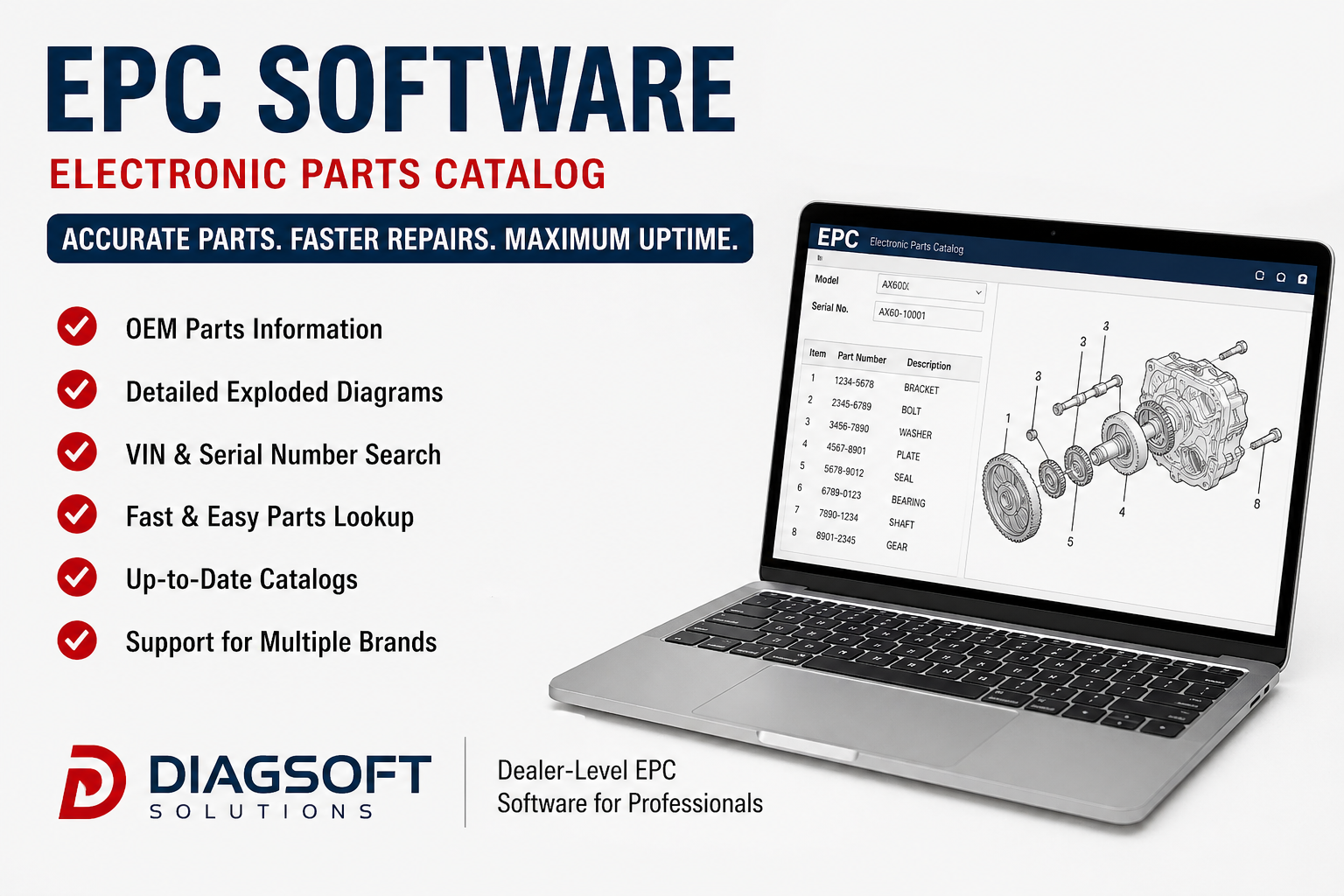
As trucks, heavy equipment, and agricultural machinery become more advanced, identifying the correct parts is no longer straightforward.
A single machine can have multiple configurations, engine variants, and production updates that directly affect which components are required.
This is where EPC (Electronic Parts Catalog) software becomes an essential tool for workshops, technicians, and parts suppliers who need accuracy and speed in every repair process.
What Is EPC Software?
EPC software is a digital system that allows users to identify original parts based on detailed machine data such as:
- VIN (Vehicle Identification Number)
- Engine model and serial number
- Equipment configuration
- Production year and region
Instead of relying on manual searches or guesswork, EPC systems provide direct access to OEM part numbers, diagrams, and structured assemblies.
Why EPC Software Matters Today
Modern diesel engines and equipment systems are highly precise. Even small variations between models can result in different part requirements.
Using the wrong component can lead to:
- Installation failure
- Compatibility issues
- Additional mechanical problems
- Increased downtime
With professional EPC software, technicians can work with exact manufacturer data and eliminate these risks.
Core Capabilities of Advanced EPC Systems
High-level EPC platforms provide more than just part lookup.
They typically include:
- Detailed exploded diagrams of assemblies
- VIN-based filtering for exact matching
- Part number history and supersession tracking
- Cross-referencing between components
- Structural breakdown of systems
This allows technicians to understand not only which part is needed, but also how it fits within the entire system.
OEM EPC Software – Built Per Brand, Just Like Dealer Systems
In real workshop environments, there is no true “one-size-fits-all” EPC system.
Each manufacturer develops its own dedicated EPC platform, built specifically for its vehicles, engines, and equipment.
These systems are the same ones used by authorized dealers and are designed to provide exact, manufacturer-level accuracy.
That means if you are working on multiple brands, you will typically need separate EPC software for each manufacturer, such as:
- Caterpilllar parts catalog systems
- Volvos and Volvos CE EPC platforms
- PACCAR (DAF, Kenworth, Peterbilt) parts catalogs
- JD agricultural EPC systems
- CNH (Case IH / New Holland) parts catalogs
- Detroit Diesel and Cummiins parts identification systems
Each of these platforms is structured differently and contains brand-specific data, diagrams, and part logic that cannot be accurately replicated in generic tools.
Combining EPC Software with Diagnostics
EPC software becomes significantly more powerful when used together with diagnostic tools.
Diagnostics help identify the fault, while EPC software allows you to:
- Locate the exact replacement part
- Confirm compatibility
- Understand the system structure
For a complete workflow, technicians often use
OEM-level diagnostic software platforms
alongside EPC systems to ensure accuracy from diagnosis to repair.
OEM Data vs Generic Catalogs
Not all parts catalogs provide the same level of accuracy.
Generic systems may lack updated information or precise compatibility details. In contrast, OEM-level EPC software provides:
- Manufacturer-verified data
- Exact part matching
- Structured and detailed diagrams
- Updated part number references
This level of accuracy is especially important for modern ECU-controlled systems.
Applications Across Industries
EPC software is used across multiple sectors where precision and efficiency are critical.
In truck repair and fleet maintenance, it helps reduce downtime by ensuring correct parts are identified quickly.
In construction equipment, it supports machines operating under heavy load where reliability is essential.
In agriculture, it allows fast and accurate repairs during time-sensitive seasons.
In industrial environments, it ensures compatibility and continuity in complex systems.
Practical Example
A technician diagnosing a fault in a heavy-duty truck identifies a failed sensor using diagnostic software.
Without EPC software, finding the correct replacement part can be time-consuming and prone to error.
With EPC software, the technician can use VIN-based lookup to identify the exact part number, view its location within the system, and confirm compatibility before installation.
Why Professionals Use EPC Software
Using EPC software improves workflow in several key ways:
- Faster and more accurate part identification
- Reduced risk of ordering incorrect components
- Improved repair efficiency
- Lower operational costs
For modern workshops, EPC software is no longer optional — it is a core part of the repair process.
Accessing OEM EPC Systems
Professional workshops and technicians rely on dealer-level EPC software platforms to ensure accuracy and efficiency in every repair.
You can explore available systems here:
OEM EPC software solutions by brand
These solutions provide access to the same structured data used by dealerships, allowing technicians to work with confidence across different platforms.
Final Thoughts
As vehicles and equipment continue to evolve, accurate part identification becomes increasingly critical. EPC software provides a structured and reliable way to access OEM data and ensure every repair is done correctly.
When combined with professional diagnostic tools, it gives technicians full control over the entire process, from identifying the issue to installing the correct component.
Discover more from Diagsoft Solutions
Subscribe to get the latest posts sent to your email.
