Blog
Why Professional Workshops Rely on OEM Service Functions Instead of Generic Scan Tools

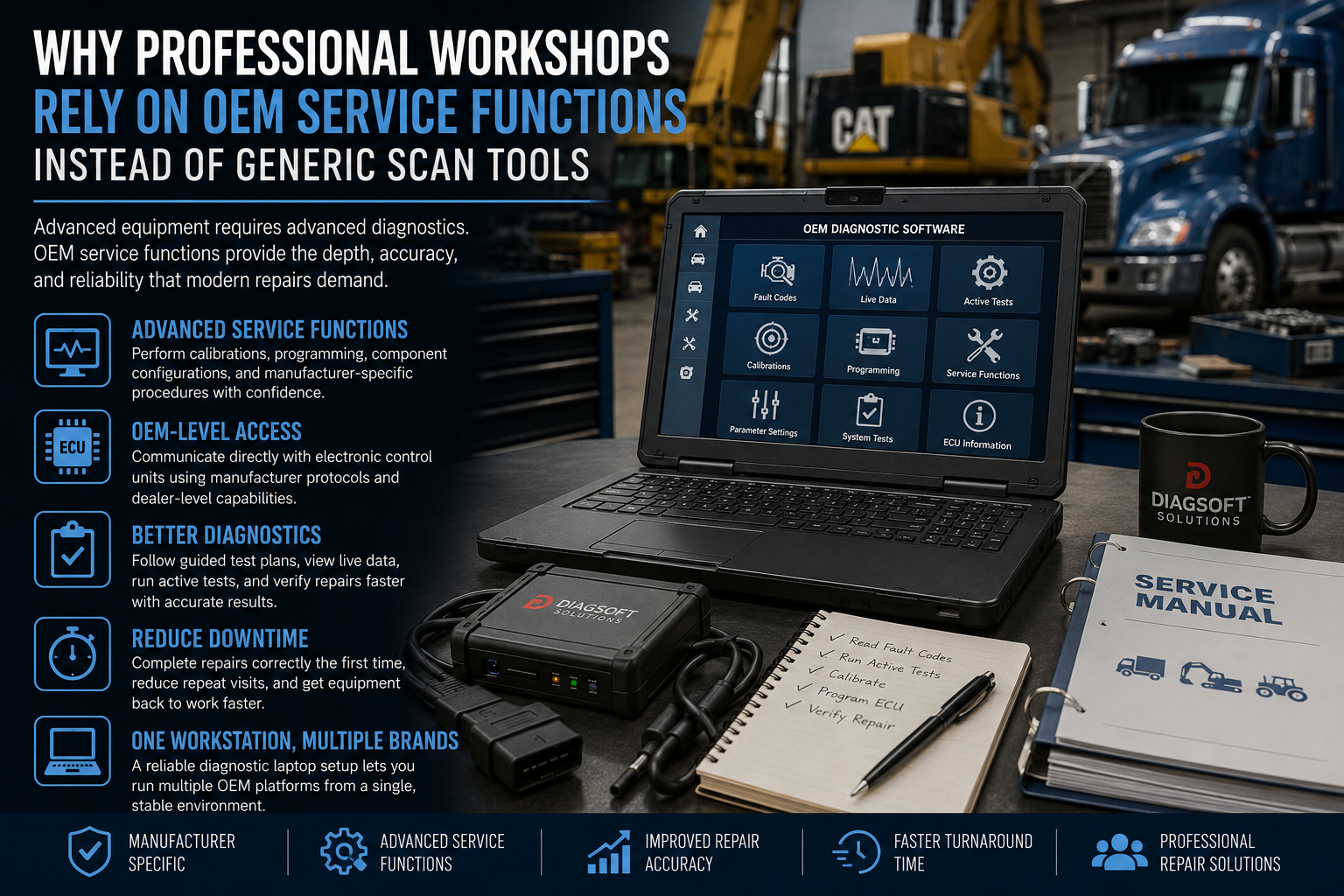
Modern heavy equipment has changed dramatically over the past decade. Today’s construction equipment, agricultural machinery, commercial trucks, and industrial engines rely on sophisticated electronic control units (ECUs) that manage nearly every major system. From engine performance and emissions control to hydraulic systems and transmissions, software has become just as important as mechanical components.
Because of this evolution, professional repair workshops have also changed the way they diagnose and repair equipment. While generic scan tools still have their place, experienced technicians increasingly depend on OEM diagnostic software whenever advanced repairs, programming, or calibration procedures are required.
Understanding the difference between these two approaches can help workshops improve efficiency, reduce downtime, and deliver more accurate repairs.
Generic Scan Tools Have Their Place
Universal diagnostic scanners remain valuable tools for many repair situations.
They are often useful for:
- Reading basic diagnostic trouble codes (DTCs)
- Clearing inactive faults
- Viewing limited live sensor data
- Performing quick inspections
- Supporting multiple manufacturers with one interface
For routine maintenance and simple diagnostics, these capabilities may be sufficient.
However, modern equipment frequently requires far more than simply identifying a fault code.
Reading Fault Codes Is Only the First Step
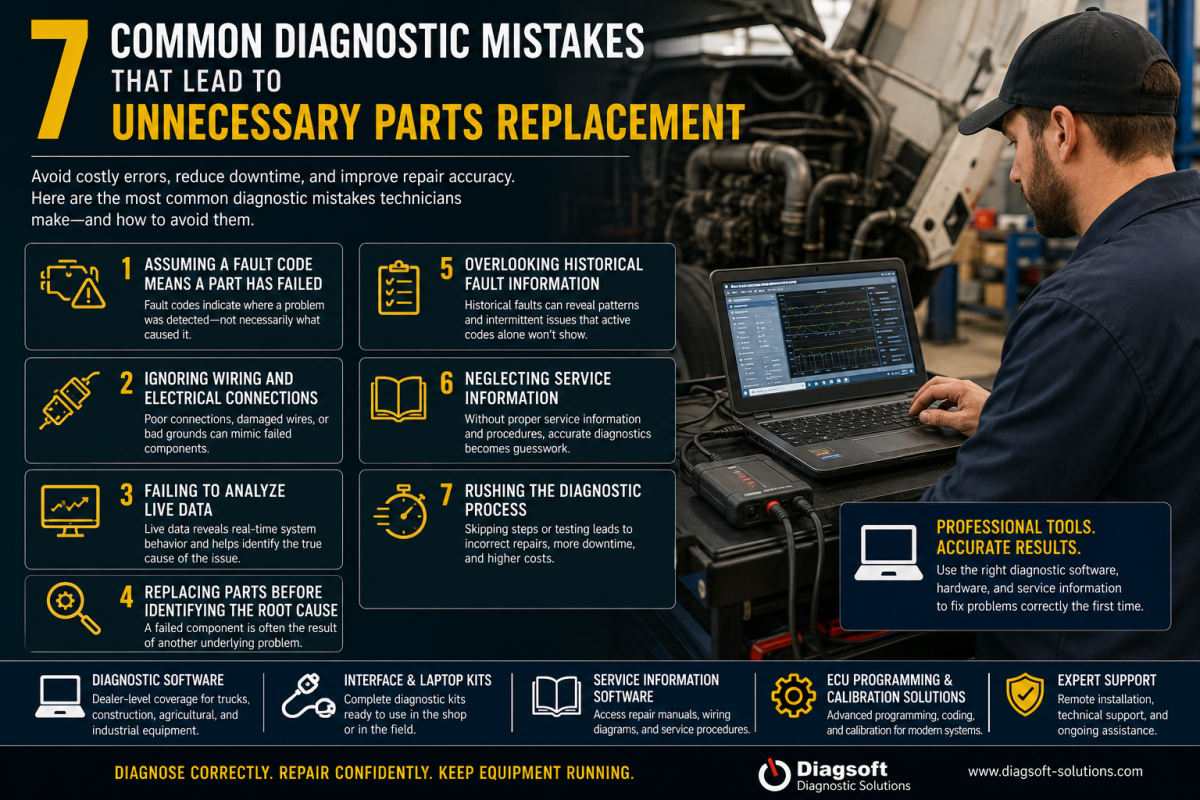
A diagnostic trouble code rarely tells the complete story.
For example, a fault indicating low rail pressure could originate from several completely different problems:
- Fuel supply restrictions
- Sensor failures
- Wiring issues
- Injector leakage
- High-pressure pump wear
- ECU configuration problems
Professional technicians therefore continue the diagnostic process by analyzing live operating data, performing active component tests, reviewing historical fault information, and following manufacturer troubleshooting procedures.
This deeper level of diagnostics often requires manufacturer-specific communication that generic scan tools simply cannot provide.
Why OEM Diagnostic Software Makes the Difference
OEM diagnostic software is designed specifically by the equipment manufacturer.
Rather than offering only general communication with the machine, these systems provide access to functions developed for that exact platform.
Many professional workshops rely on dealer-level diagnostic software because it allows technicians to perform operations that are simply unavailable with universal scanners.
These include:
- ECU programming
- Parameter configuration
- Injector coding
- DPF regeneration
- Transmission adaptations
- Hydraulic calibration
- Sensor initialization
- Active component testing
- Guided troubleshooting procedures
- Software updates
- Service interval configuration
These advanced capabilities significantly improve repair accuracy while reducing unnecessary parts replacement.
Modern Repairs Often Require Programming
Today’s repair process frequently continues long after a defective component has been replaced.
Installing a new module often requires:
- Programming
- Coding
- Configuration
- Calibration
- Learning procedures
Without completing these steps correctly, the machine may continue displaying faults even though the mechanical repair has already been completed.
Professional OEM diagnostic platforms allow technicians to perform these manufacturer-required procedures exactly as intended.
Supporting Multiple Equipment Brands
Independent repair businesses rarely specialize in only one manufacturer.
Many workshops routinely service:
- Excavators
- Wheel loaders
- Skid steer loaders
- Agricultural tractors
- Harvesting equipment
- Heavy-duty trucks
- Industrial diesel engines
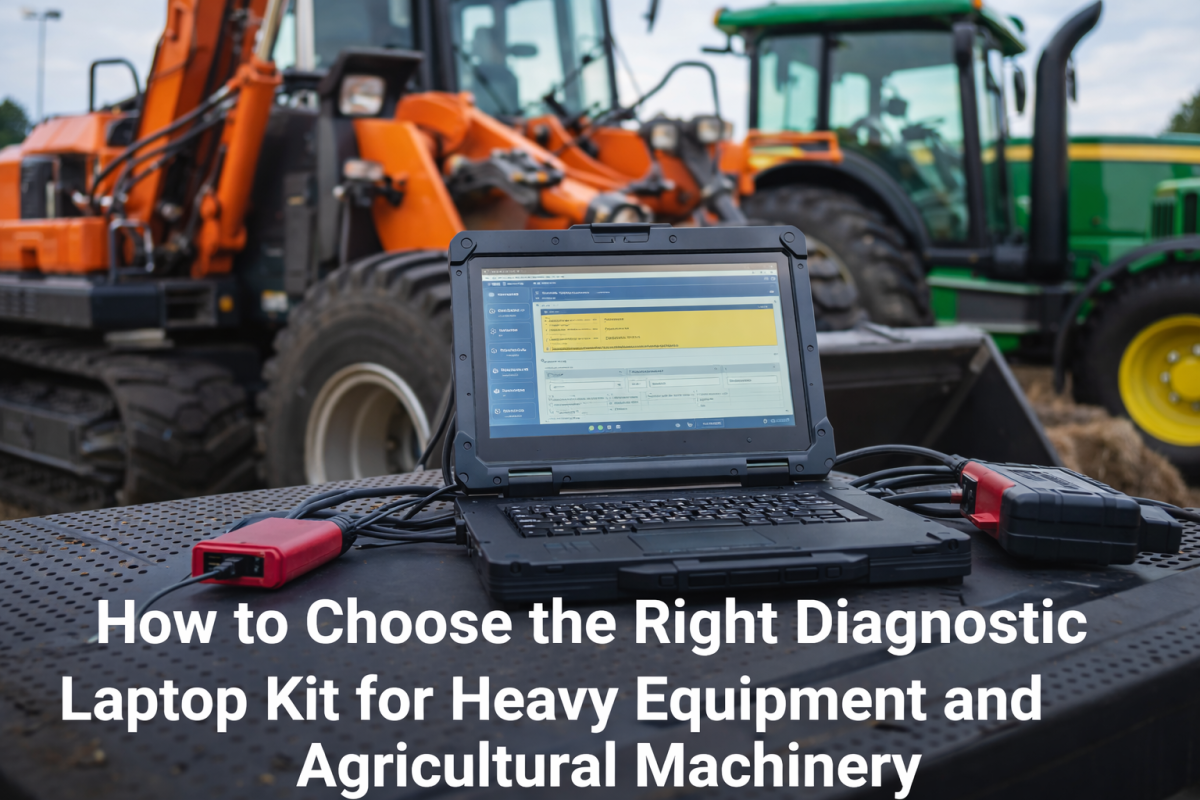
Instead of maintaining multiple computers for every brand, many professionals build a dedicated diagnostic laptop kit capable of supporting several OEM diagnostic platforms from a single workstation.
This simplifies software management while improving workshop productivity.
Communication Quality Matters
Successful diagnostics depend on reliable communication between the computer and the machine.
Professional workshops therefore invest significant effort into maintaining a stable diagnostic environment.
A properly configured workstation typically includes:
- Stable Windows installation
- Reliable USB communication
- Manufacturer-approved drivers
- SSD storage
- Backup images
- Power management optimization
- Organized software installation
These small details often prevent communication failures that waste valuable repair time.
Faster Diagnostics Mean Less Downtime
Equipment downtime represents one of the largest costs for contractors, fleet operators, farms, and industrial facilities.
Every additional hour spent diagnosing a machine can delay projects, increase labor costs, and reduce equipment availability.
OEM diagnostic software helps technicians:
- Access complete fault information
- Verify repairs quickly
- Perform manufacturer service routines
- Reduce repeat repairs
- Improve first-time repair success
- Minimize unnecessary downtime
The result is better service for customers and more efficient workshop operations.
OEM Service Functions Go Beyond Diagnostics
Many technicians think of diagnostic software only as a fault-code reader.
In reality, dealer-level platforms serve as complete service tools.
Examples of advanced OEM service functions include:
- DPF service procedures
- Turbo actuator calibration
- Hydraulic pump setup
- Injector replacement coding
- Transmission clutch calibration
- Steering angle sensor reset
- Engine performance testing
- ECU replacement programming
- Aftertreatment configuration
- System learning procedures
These operations often determine whether a repair is fully completed.
Building a Professional Diagnostic Workflow
Experienced workshops understand that successful diagnostics involve more than software alone.
An efficient workflow combines:
- OEM diagnostic software
- Reliable communication hardware
- Technical documentation
- Experienced technicians
- Structured troubleshooting procedures
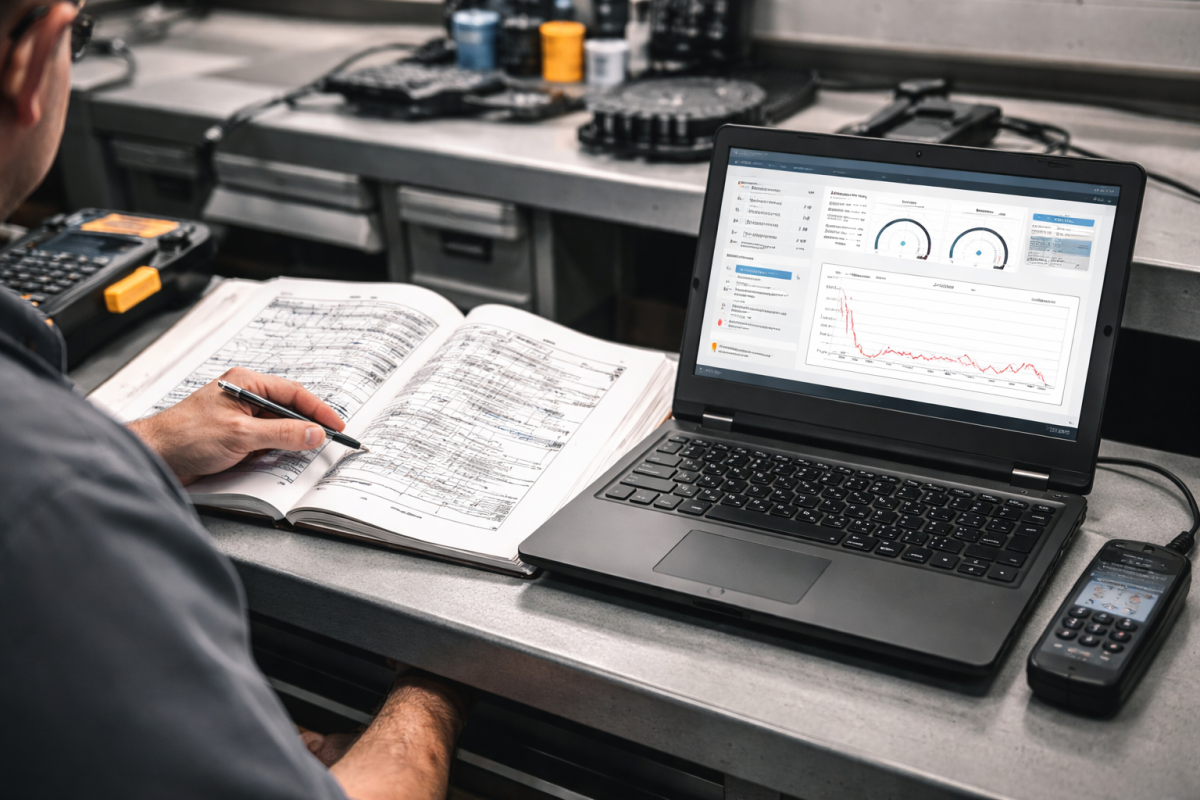
Many repair facilities also maintain digital service libraries alongside their diagnostic platforms, allowing technicians to quickly access wiring diagrams, hydraulic schematics, specifications, and repair procedures during troubleshooting.
When these resources work together, repairs become faster, more consistent, and more accurate.
Preparing for Future Equipment
Heavy equipment continues to become more software-driven every year.
Advanced driver assistance systems, emissions technologies, telematics, electronic hydraulics, and intelligent engine management all require increasingly sophisticated diagnostic capabilities.
As machines evolve, workshops that invest in professional diagnostic environments will be better prepared to service both current and future equipment.
Rather than reacting to increasing complexity, they position themselves to handle modern repairs confidently and efficiently.
Final Thoughts
Generic scan tools remain useful for basic maintenance and simple fault-code reading.
However, modern equipment increasingly requires manufacturer-specific service functions, programming, calibration, and advanced diagnostics that only OEM platforms can provide.
Professional workshops recognize that investing in the right diagnostic environment is not simply about purchasing software—it is about improving repair quality, reducing downtime, increasing technician productivity, and providing customers with reliable, accurate service.
As today’s trucks, construction equipment, agricultural machinery, and industrial engines continue to become more advanced, OEM diagnostic software is becoming an essential part of every professional repair operation.
Discover more from Diagsoft Solutions
Subscribe to get the latest posts sent to your email.